The Question Everyone Asks Eventually
If you've spent any time in a camera app's settings, you've probably seen the option to shoot in RAW instead of the standard JPEG (or HEIC). And you've probably wondered whether it's worth switching — or whether it's just a setting for professionals that doesn't apply to you.
The honest answer is: it depends on what you're shooting and what you plan to do with it afterward. But to make that call for yourself, it helps to actually understand what the difference is — not just in file size, but in what each format lets you do.
What a JPEG Actually Is
A JPEG is a processed, compressed, ready-to-share image. When your phone captures a photo and saves it as a JPEG, it has already made a series of decisions for you — brightness, contrast, color, sharpening, noise reduction — and baked those decisions into a compressed file.
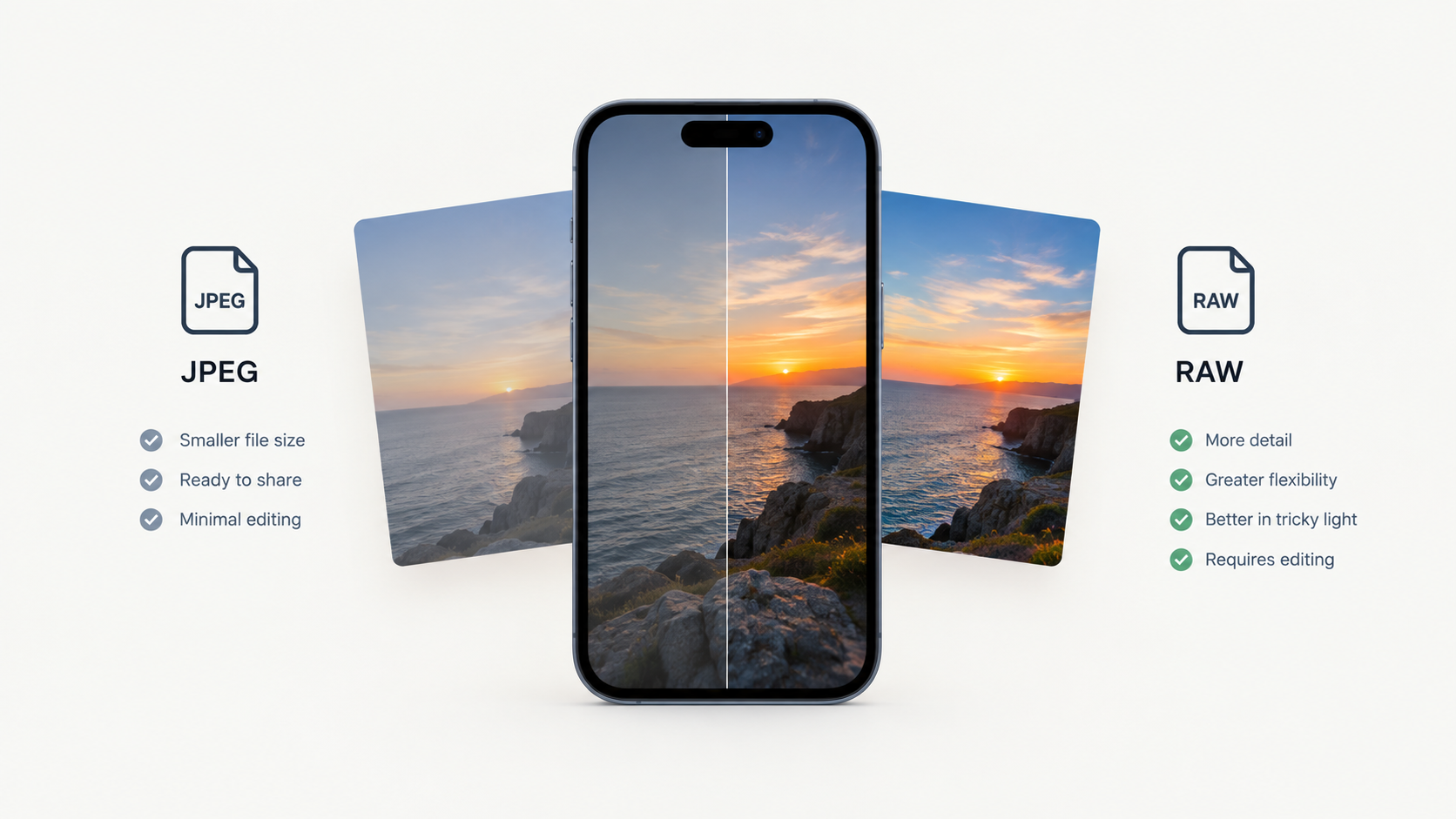
The upside of this is real and shouldn't be dismissed: JPEGs look good immediately. You don't need to do anything to them. They're small, so they don't eat up your storage, they upload and share quickly, and for the vast majority of photos people take, they're simply fine as-is.
The trade-off is flexibility. Because the phone already discarded extra information during compression, you're limited in how much you can change later. You can nudge brightness or contrast a little, but you can't recover detail that was never kept in the first place.
What a RAW File Actually Is
A RAW file is the sensor's original, unprocessed data. Instead of applying brightness, contrast, color, and sharpening decisions and then compressing the result, a RAW file holds onto the information the sensor captured before any of those choices were made.
This has a direct consequence: RAW files are larger, sometimes significantly so, because they're not throwing information away. And they often look flat or unfinished straight out of the camera — less contrast, duller color, less "pop" — because none of the enhancement a JPEG applies automatically has happened yet.
That flatness isn't a flaw. That's the point. A RAW file needs editing to look finished, but in exchange, it holds far more detail in the shadows and highlights, and far more flexibility in color, than a JPEG ever could.
What RAW Actually Lets You Do That JPEG Can't
This is the part that matters most, because it's not abstract — it shows up in real shooting situations:
Recovering a blown-out sky. Shoot a sunset or a bright window and the sky often turns into a flat white blob in a JPEG — that detail was discarded during processing and compression. In a RAW file, that highlight information is frequently still there, recoverable in editing.
Brightening a dark subject without it falling apart. Push the exposure up on a too-dark JPEG and you'll often see blotchy color, harsh noise, or banding — because the phone already compressed away the fine detail in those shadow areas. A RAW file holds more of that shadow detail intact, so brightening it tends to look cleaner.
Shifting white balance and color cleanly. If a JPEG's color temperature is off — too warm, too cool, an odd tint from mixed lighting — correcting it after the fact can look unnatural, because the color decisions are already baked in. RAW files let you set white balance after the shot with much more accuracy, since the original color data hasn't been processed yet.
Pulling detail from shadows. Dark areas of a JPEG often just look like flat black with little to work with. RAW files typically retain more tonal information in those shadow areas, so you can bring out detail that a JPEG simply never kept.
The Honest Trade-Offs of RAW
None of this means RAW is simply "better" in every situation. It comes with real costs:
- Bigger files. RAW files can be several times the size of a JPEG, which adds up fast if you're shooting a lot and storage is limited.
- It requires editing to look finished. Straight out of the camera, a RAW file usually looks flatter and less polished than a JPEG. If you're not going to edit it, you're just carrying around a bigger, less finished-looking file for no benefit.
- It's overkill for casual snapshots. A quick photo of a coffee cup for a text message, a screenshot-worthy meme, a fast group photo — none of that needs the extra flexibility RAW provides. JPEG is not just adequate here, it's the better choice, because it's smaller and already looks good.
Who Actually Benefits From Shooting RAW
RAW makes the most sense for two overlapping groups:
- Anyone who wants to edit their photos seriously — not just a quick brightness tweak, but real adjustments to exposure, color, and tone, where having more original data to work with makes a visible difference in the final result.
- Anyone shooting in tricky light — sunsets, backlight, high-contrast scenes with both very bright and very dark areas in the same frame. These are exactly the conditions where a JPEG's limited highlight and shadow detail becomes a real problem, and where RAW's extra information pays off.
If neither of those describes what you're doing, JPEG is genuinely the right call — not a compromise, just the better fit for the task.
Shoot RAW When… / JPEG Is Fine When…
| Shoot RAW when... | JPEG is fine when... |
|---|---|
| You plan to seriously edit the photo afterward | You just want a quick, shareable shot |
| You're shooting in high-contrast light (sunsets, backlight, bright skies) | The lighting is even and straightforward |
| You need to recover blown-out highlights or dark shadows | The shot already looks good straight out of camera |
| You want precise control over white balance and color | You're not planning to edit the photo at all |
| Storage space isn't a major concern | You're shooting a lot of photos and want to save space |
| The photo matters enough to be worth the extra editing time | Speed and convenience matter more than flexibility |
So, Should You Shoot RAW?
There's no single right answer — and that's really the honest takeaway here. RAW isn't a strictly better format that everyone should switch to, and JPEG isn't a lesser format that only casual users settle for. They're built for different jobs.
JPEG is optimized for convenience: small, fast, ready to go, and genuinely good enough for the overwhelming majority of everyday photos. RAW is optimized for control: larger, unfinished-looking on its own, but holding onto the detail and flexibility that matter when a photo is difficult to shoot correctly the first time, or important enough to be worth editing properly.
The practical approach most people land on is situational — JPEG for daily shots, RAW for the moments where lighting is difficult or the photo genuinely matters. If you decide RAW is worth trying, the main barrier for most phone users isn't the concept, it's the tooling: standard camera apps don't always make RAW capture and editing simple. Apps like Snapback exist specifically to make RAW capture and editing easy on iPhone, without needing a separate dedicated camera.
Either way, understanding the actual difference — not just "RAW is better" or "JPEG is fine" as a blanket rule — is what lets you make that call for yourself, photo by photo, instead of guessing.